Organic traffic is game-changing when handled professionally. Most people think, ‘Why hire an SEO company?’ instead of asking, ‘How do I hire the right one?’ You can’t manage everything as a one-man show. And without a specialized SEO company, spending large amounts on ads isn’t a sustainable solution for the ecommerce marathon.
So, stop renting your audience. In the volatile ecommerce landscape of 2026, relying solely on paid ads is like sailing a high-value merchant ship through the Strait of Hormuz—one geopolitical flare-up, one algorithm shift, or one sudden price hike in freight, and your entire supply chain of customers is cut off.
To build a brand that survives, you need to own the ocean. You need an ecommerce SEO strategy that turns your site into a high-speed revenue engine, independent of the “toll booths” of Meta and Google.
Executive Summary | The Strategic Mandate
Hiring an eCommerce SEO services company is no longer about “getting more clicks.” In the era of Agentic Commerce, it is about infrastructure. Specialized agencies provide the technical architecture and AI-tuning that are too complex and costly to manage in-house.
By moving from a “Trial and Error” DIY mindset to data-backed search intent analysis, you fix critical leaks—like crawl traps and slow page speeds—before they impact your bottom line.
The result? Sustainable traffic, brand credibility, and a steady flow of sales without the recurring debt of ad-spend.
Why Hire an SEO Company — Benefits, ROI & What to Expect
1. The “Expert vs. Amateur” Gap | Why SEO Isn’t a “Figure It Out” Game
If you own a brand today, you’ve likely tried to master the basics of Search Engine Optimization yourself. But here is the cold reality of 2026: SEO has moved beyond “keywords” into the realm of Data Engineering.
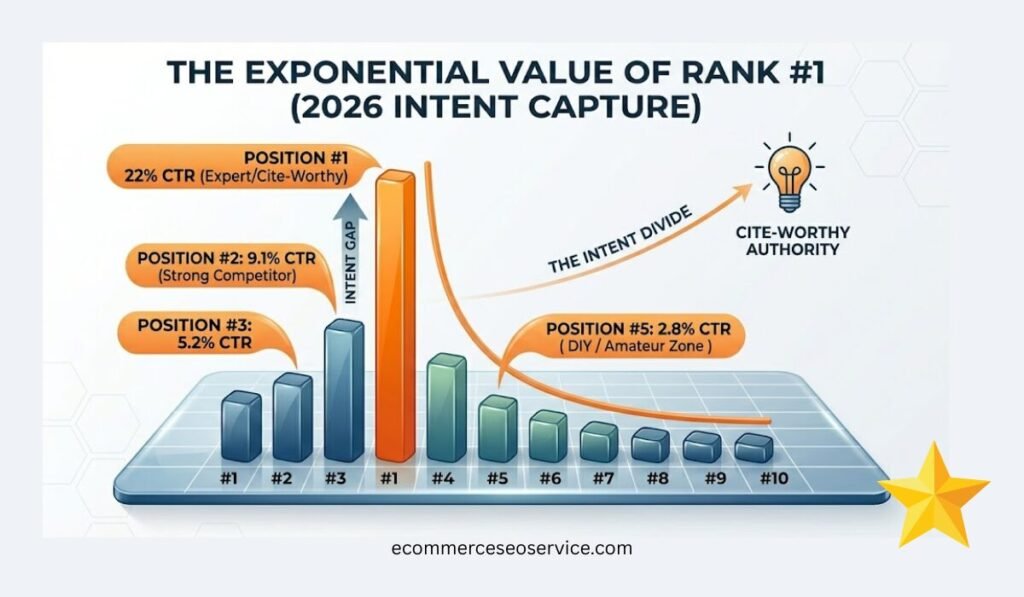
In the early days, you could rank by just being “present.” Today, if you don’t have a solid grasp of Multi-Vector Retrieval (MUVERA) and Entity-Based Search within the first 90 days of your site’s life, you aren’t just slow—you are invisible.
Working with an expert isn’t about getting “advice”; it’s about crossing the “Intent Divide” that keeps 90% of Shopify and Magento stores stuck on page four.
💡 Pro Tip
The “Knowledge Half-Life” in 2026 is about six months. What worked during last year’s Q4 is a liability today. An expert ensures your technical foundation is constantly “re-tuned” to match Google’s weekly algorithm micro-adjustments.
2. The 22:1 Return | Decoding the Mathematical Worth of an Expert
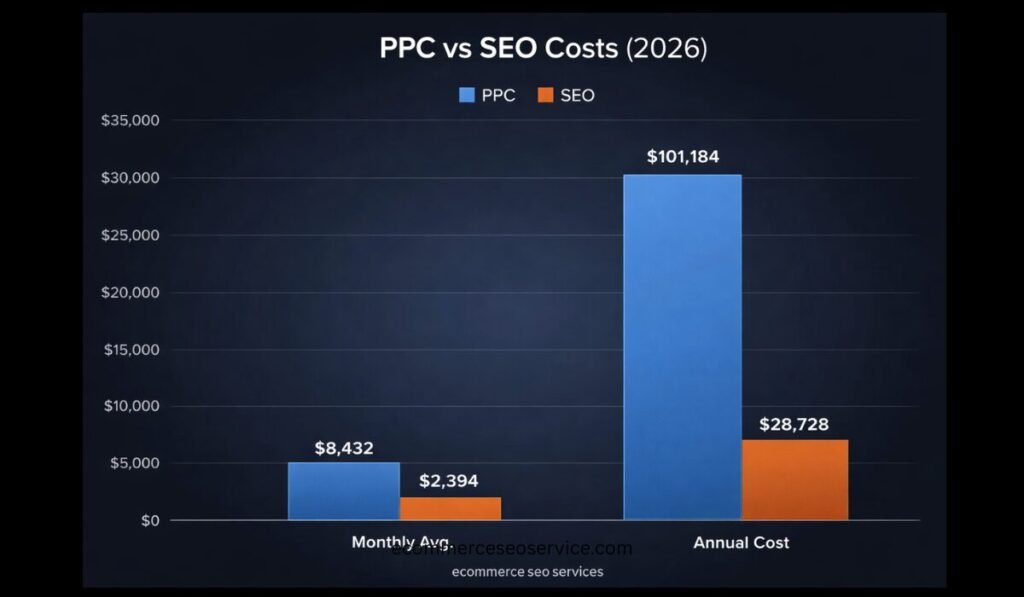
Why hire an SEO company if the costs don’t outweigh the benefits? Let’s look at the hard data from the US and UK markets. While Paid Ads (PPC) are essential for immediate cash flow, they are a linear investment. You pay for every single click.
The ROI Disparity (2026 Benchmarks):
- PPC Cost per Lead: On average, 4x higher than SEO-generated leads.
- The Compounding Effect: For every $1 invested in a professional ecommerce SEO strategy, the market sees an average return of $22.24.
Hiring an expert isn’t an expense; it’s the acquisition of a Revenue Asset that grows in value even when your ad account is paused.
3. The Economy of Scale | A Full Team for the Cost of One Salary
A common mistake in the US market is hiring a single “Marketing Manager” to solve an SEO problem. In 2026, SEO is a symphony of specialized disciplines.
To rank at scale, you need a team that covers Technical Architecture, Content Strategy, Digital PR, and Data Analytics.
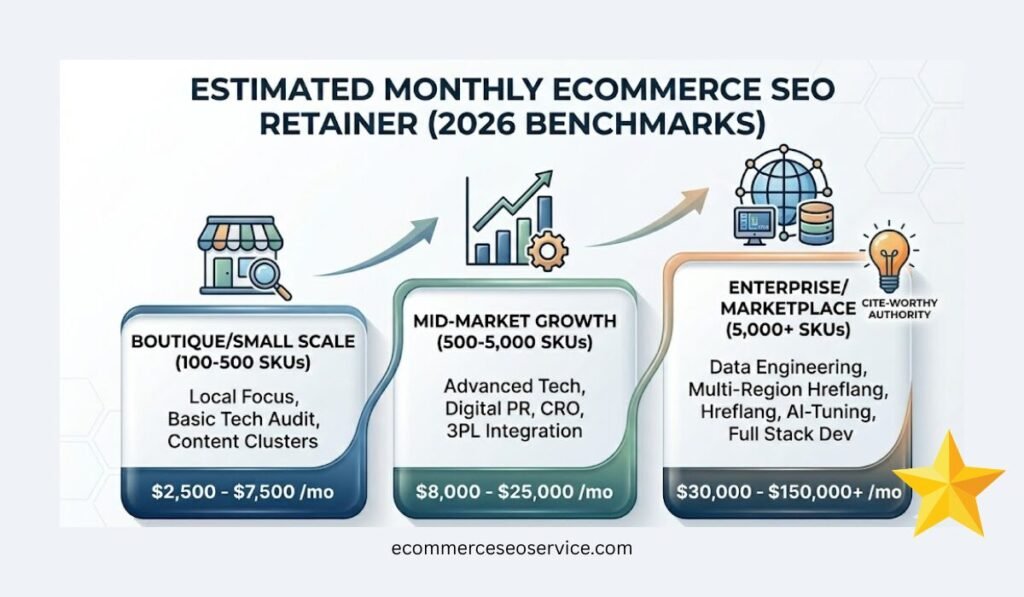
| Resource Type | Typical US Salary (In-House) | Agency Partnership (Fee) |
| SEO Strategist | $110,000 /yr | Included |
| Technical Specialist | $125,000 /yr | Included |
| Copywriter (E-E-A-T) | $85,000 /yr | Included |
| Link Building/PR | $95,000 /yr | Included |
| Total Overhead | $415,000 /yr | $36k – $120k /yr |
💡 Pro Tip
When vetting an agency, ask for their “Specialist-to-Account Ratio.” If one person is doing your technical audit, writing your blogs, and building your links, you haven’t hired an agency; you’ve hired a stressed freelancer with a fancy logo.
4. 7 Strategic Business Wins of an Agency Partnership
- Eliminating Technical Debt: Most ecommerce mistakes are “Invisible Errors”—like failing to implement Merchant Listing Schema or having a “Crawl Trap” in your navigation.
- Conversion Intent Analytics: We don’t look at “traffic”; we look at what the world is searching for now to decide which products you should focus on.
- Structural Integrity: An agency ensures your site is built like a high-performance engine (URL hierarchy and code efficiency) from the start.
- Focus on Your “Zone of Genius”: As a founder, your time is worth hundreds of dollars per hour. Don’t waste it on Canonical Tag logic.
- Competitive Displacement: Your competitors are already using experts. Don’t bring a knife to a drone fight.
- The Roadmap to Revenue: We provide the data-backed map to reach your targets via the “shortest path” to high-converting traffic.
- Growing Without the Overhead: Scale your team’s capabilities without the massive US-based payroll burden.
5. Winning the “Agentic Shelf” and Algorithm Updates
The April 2026 Core Update is officially demoting “Ghost Brands”—sites with stock photos and AI-spun content. Google is looking for “Information Gain” and “Proof of Life.”
If a user asks an AI assistant, “What is the best sectional sofa for a narrow London flat?” and Google doesn’t cite you, that traffic is gone. We transition your brand from traditional “Blue Links” to being a Cite-Worthy Answer Agent.
💡 Pro Tip
Target Long-Tail “Problem” Keywords (10-15 words). In 2026, these generate a 1.76x higher click-through rate. Instead of “blue sofa,” target “modular navy blue sofa that fits through a 28-inch apartment door.”
6. The “Zero-Gap” Framework | Logistics as the New SEO
Most agencies fail because they don’t speak “Retail.” They might get you to #1 for a keyword, but if that product is sitting in a shipping container in the Gulf or is out of stock in your 3PL warehouse, they’ve failed your business.
The Professional Difference:
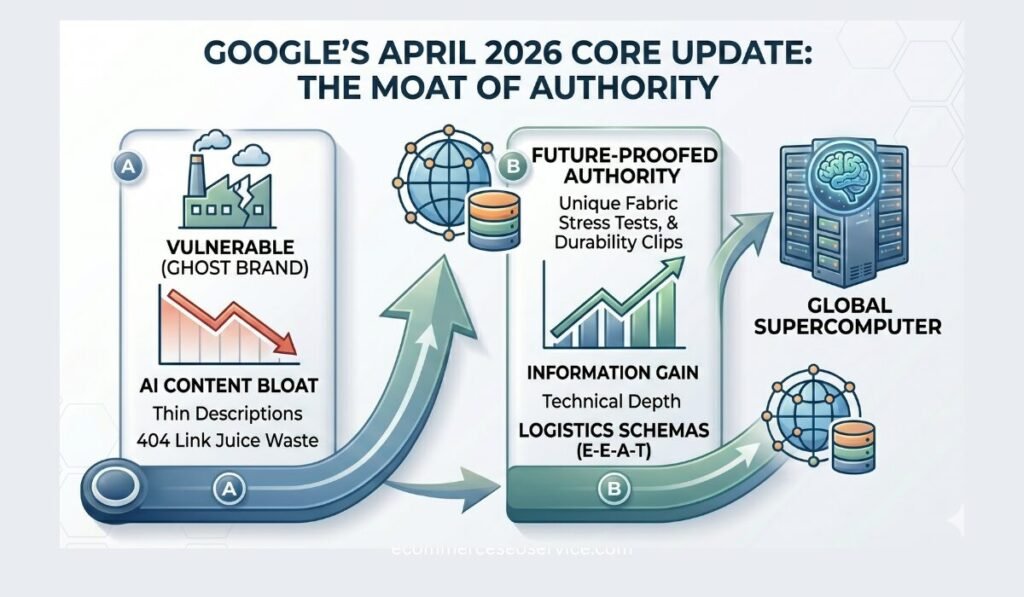
We sync your SEO roadmap with your warehouse velocity. We build the “authority” for products while they are still in transit, ensuring that when the shipment arrives, the rankings are already there to meet the demand.
FAQ | Why hire an seo company
Why hire an SEO company instead of doing it myself?
In 2026, SEO is a complex infrastructure project involving APIs and AI-tuning. Doing it yourself isn’t “saving money”—it’s an opportunity cost that lets competitors steal your market share.
Can’t I just use ChatGPT for my content?
You can, but Google will know. AI-only content lacks “Entity Authority.” We use AI for research, but a human storyteller for the final narrative to satisfy Google’s 2026 E-E-A-T signals.
What happens to our SEO when a product sells out?
We use a Zero-Gap Strategy. We keep the page live, add an “Email Me” button, and show related products. We never let a page return a 404 error and waste your earned “Link Juice.”
How does an SEO Company measure success?
The SEO company tracks Organic Revenue, Assisted Conversions, and Customer Acquisition Cost (CAC). If a ranking doesn’t lead to a sale, it’s a vanity metric.
Is it worth hiring an SEO agency?
Heck yes—if you value your time and your sanity. You can fix your own plumbing, but you wouldn’t build a skyscraper without an architect. In 2026, SEO is no longer a “task”; it’s a high-level infrastructure project involving APIs, AI-tuning, and Digital PR.
Hiring an agency isn’t an expense; it’s an investment in a Revenue Asset. While you focus on your “Zone of Genius” (running your business), the agency focuses on keeping your brand from becoming a “Ghost Brand.”
The alternative isn’t “free” SEO; it’s the massive opportunity cost of your competitors stealing your market share while you’re stuck reading technical documentation.
What is the 80/20 rule of SEO?
In 2026, 80% of your revenue will come from 20% of your pages—usually your high-intent Category Pages and specific Comparison Frameworks. Most amateurs waste 80% of their time writing “fluff” blogs that nobody reads.
A pro agency flips the script. We spend 80% of our energy optimizing the 20% of “Money Pages” that actually move the needle in your warehouse. We focus on the high-margin, high-velocity items that protect your bottom line, ensuring that every ounce of “Link Juice” is funneled where it makes you the most profit.
Is SEO dead or evolving in 2026?
SEO isn’t dead; it just graduated. The old SEO (stuffing keywords into white text) is buried. The new SEO is Agentic Commerce. It’s about being “Cite-Worthy.” With the April 2026 Core Update, Google has shifted from being a search engine to an Answer Engine.
If you are still trying to rank “Blue Links” without providing Information Gain, you are chasing a ghost. SEO has evolved into a sophisticated blend of technical data engineering and high-level human storytelling.
It’s more alive than ever, but the barrier to entry is much higher.
How much does it cost to pay someone for SEO?
You get exactly what you pay for. You can find someone for $500/month, but they’ll likely do more damage than good by using “Black Hat” tactics that get you penalized.
For a high-growth US or UK ecommerce brand, a professional monthly retainer typically ranges from $2,500 to $25,000+, depending on your SKU count and technical complexity.
Think of it this way: you aren’t paying for “content”; you are paying for a Special Ops team that manages a $400k/year skill set for a fraction of the price. If the SEO is “cheap,” it’s the most expensive mistake you’ll ever make.
Can ChatGPT do SEO?
ChatGPT is a great research assistant, but it’s a terrible strategist. If you use AI to generate your entire SEO strategy, you are producing “Average Content” by definition.
In 2026, Google’s MUVERA algorithm is designed to sniff out and demote generic AI-spun junk. AI can help us find data, but it can’t perform a Fabric Stress Test, it can’t negotiate a Digital PR link with a journalist, and it certainly doesn’t understand your 3PL warehouse velocity. Use AI as a tool, but keep a human at the wheel if you want to rank.
Will SEO exist in the next 5 years?
As long as people have problems and products provide solutions, SEO will exist.
However, in five years, it won’t be called “Search Engine Optimization”—it will be AIO (Answer Interface Optimization). We won’t be optimizing for a screen; we’ll be optimizing for the “Voice” and “Agent” that lives in a user’s ear.
The core principle remains the same: Trust and Authority. If your brand is the “Source of Truth,” you will always win, whether the user is typing into a bar or asking their AI glasses to find them a new sofa.
Final Thoughts | Ownership vs. Renting
The opportunity cost of being invisible to AI agents and search engines is a total loss of market share. Do not put all your eggs in the ad-spend basket. In a world of geopolitical instability and “Strait of Hormuz” shipping crises, SEO is your only true shield.
Don’t leave your brand stranded. Build a bonfire. Own your ocean.
Ready to turn your search visibility into warehouse velocity?