
How much to pay for ecommerce SEO depends on more than just a number—it’s a formula, if you ask me. And here’s how I see it:
SEO Cost = Value Promised + Mutual Trust + Agency’s Experience & Structure + Success Rate + Your Budget
Let me break it down for you:
- Value Promised: What tangible results is the agency guaranteeing? More traffic? Higher conversions? Real revenue?
- Mutual Trust: Are you confident in their honesty, communication, and transparency?
- Agency’s Experience & Structure: Do they have a proven process, skilled team, and prior ecommerce success stories?
- Success Rate: Look for metrics and case studies—how many clients actually achieved measurable growth?
- Your Budget: Finally, what can you comfortably invest while expecting a fair ROI?
The truth is, there’s no one-size-fits-all SEO price. Every ecommerce store, niche, and growth goal is different. And if you focus only on the “cheapest package,” you might pay later in lost revenue.
Why SEO Pricing Can Vary So Much?
SEO is not a simple service. It’s a system. Some agencies charge per hour, others per project, and some on a monthly retainer. Costs vary based on:
- Your ecommerce store size
- Number of products
- Current site health
- Competition in your niche
- Agency experience
Big US ecommerce players like Chewy, Wayfair, and Brooklinen invest heavily in SEO monthly—sometimes $10k–$50k+—because each sale is high value. Medium stores like Allbirds or MVMT Watches spend $2k–$8k monthly, focusing on smart keyword targeting and content strategy.
For small businesses, pricing is lower—but beware of extremely cheap services. Traffic without conversions is worthless.
Per-Hour SEO Rates for Ecommerce Stores
Hourly rates are common for freelancers and some boutique agencies.
- US-based freelancers: $50–$150/hour
- Small agency consultants: $100–$250/hour
- Experienced ecommerce SEO specialists: $200–$400/hour
Hourly work is best for:
- Quick audits
- Technical fixes
- Consulting on a short-term strategy
Example: A small apparel store hired a freelancer for $120/hour to fix page speed and product titles. In two weeks, organic traffic improved by 18%, and conversion rates jumped 12%.
Per-Project SEO Pricing for Ecommerce Stores
Some stores prefer a one-off project. Agencies quote fixed fees to optimize:
- Product pages
- Category structure
- Blog + internal linking
- Technical SEO fixes
Typical ranges:
- Small ecommerce store: $1,500–$5,000/project
- Medium store (500–1,000 products): $5,000–$15,000/project
- Large store (1,000+ products): $15,000–$50,000+
Example: A US-based home goods store hired an agency for $7,500 to audit and fix site structure. Within three months, organic traffic increased 40%, and sales rose 25%.
Monthly SEO Retainers for Ecommerce Stores
Most serious ecommerce SEO work is ongoing. Monthly retainers cover:
- Content strategy and production
- Ongoing technical fixes
- Keyword tracking and optimization
- Link building and outreach
- Conversion rate improvements
Typical US ranges:
- Small store: $1,000–$3,000/month
- Medium store: $3,000–$8,000/month
- Large store: $8,000–$25,000/month
Why monthly works: SEO isn’t a one-time task. Algorithms, buyer trends, and competitors shift. Agencies maintain momentum for growth.
Example: A mid-size supplement store on a $4,500/month retainer saw organic revenue rise by 35% in six months.
How to Decide What You Should Pay
You don’t pick numbers blindly. Consider:
- Store size and revenue potential – Bigger stores have more at stake; bigger investment makes sense.
- Services included – Technical SEO, content, link building, conversion optimization?
- Experience of the agency – Proven results beat promises.
- Reporting transparency – You need clear ROI tracking.
Mini tip: Ask agencies to show case studies with numbers, not screenshots.
SEO Pricing Packages for Ecommerce Stores | How to Deal With Agencies
As an ecommerce entrepreneur, dealing with SEO agencies can feel like stepping into a maze. You know your store, your products, and your customers better than anyone. B
ut when an agency throws around packages, pricing, and technical jargon, it can feel overwhelming. The question is simple: how do I know what’s worth paying for, and what’s fluff?
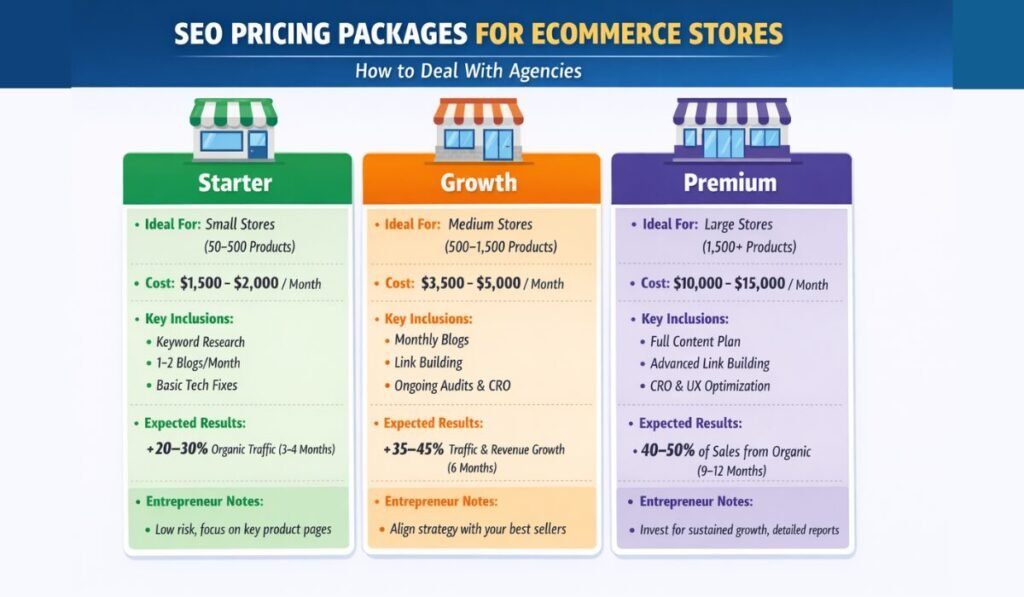
Agencies often divide their services into packages. The typical tiers you’ll see in the US market are Starter, Growth, and Premium. But understanding these packages from your perspective—not just what the agency tells you—is where the real insight lies.
| Package | Ideal For | Typical Monthly Cost (USD) | Key Inclusions | Expected Results | Entrepreneur Notes |
| Starter | Small stores (50–500 products) | $1,500 – $2,000 | Keyword research, basic content (1–2 blogs/month), minor tech fixes (speed, broken links) | Organic traffic growth 20–30% in 3–4 months; foundation for future SEO | Perfect for testing SEO without overcommitting. Focus on high-impact product pages. |
| Growth | Medium stores (500–1,500 products) | $3,500 – $5,000 | Monthly blogs, link building, ongoing technical audits, CRO recommendations | Traffic increase 35–45%; organic revenue growth 25–35% over 6 months | Works best when agency aligns strategy with your top products and buyer intent. Check deliverables carefully. |
| Premium | Large stores (1,500+ products, competitive niches) | $10,000 – $15,000 | Full content calendar, link building & outreach, CRO testing, UX improvements, schema markup, detailed audits | Organic traffic and revenue can contribute 40–50% of sales in 9–12 months | Best for stores ready for sustained growth. Agency should act proactively, adjust strategy, and focus on measurable revenue. |
1. Starter Packages – What Small Stores Actually Get
Starter packages are the entry-level option, aimed at smaller stores, usually with 50–500 products. As an entrepreneur, think of this as the foundation layer.
What’s typically included:
- Keyword research for primary product pages
- Basic content creation (sometimes 1–2 blogs per month)
- Minor technical fixes (like site speed improvements or fixing broken links)
From the entrepreneur’s perspective:
These packages are perfect if your goal is to get a solid SEO baseline. You’re not trying to outrank Amazon overnight; you want traffic that converts and fixes that prevent revenue leaks.
Example: A small US fashion store signed a starter package at $1,800/month. After three months, organic traffic jumped 27%. The store’s best-selling jackets and accessories started appearing in niche search terms like “winter bomber jacket for men” and “eco-friendly leather boots.” The agency didn’t just stop at the contract—they recommended adding category-level blogs to maintain momentum, which was a proactive step.
Pro tip: As an entrepreneur, don’t just look at cost. Ask:
- Which pages will be optimized first?
- How often will you receive progress updates?
- Are blogs designed to drive conversions or just traffic?
Starter packages work if your store is new or if you’re testing SEO without overcommitting cash. But don’t expect instant domination—this is foundation-building, not “overnight success.”
2. Growth Packages – Scaling Smart for Medium Stores
Growth packages target medium-sized stores, usually 500–1,500 products, with more competitive niches. These are designed for entrepreneurs who already have some traffic but want consistent, scalable growth.
What’s typically included:
- Monthly blogs and content strategy tailored to buyer intent
- Link building (both internal and external)
- Ongoing technical audits and fixes
- CRO (conversion rate optimization) recommendations
From the entrepreneur’s perspective:
This is where you start seeing meaningful revenue impact from SEO, not just clicks. Content isn’t just to rank—it’s to guide customers through your buying process. Internal links from blogs to product pages act like a funnel that nudges buyers closer to checkout.
Example: A mid-size US supplement store invested $4,500/month in a growth package. Within six months:
- Organic traffic increased 40%
- Revenue from organic traffic rose 35%
- Repeat customer engagement improved because blogs educated users (e.g., “How to choose the right protein powder”)
As an entrepreneur, what matters here isn’t just the monthly fee—it’s the results per dollar spent. Growth packages work best when the agency understands your niche, knows your top products, and continuously adjusts strategy based on results.
Pro tip: Always clarify deliverables. Growth packages sound great, but ask:
- How many blogs per month?
- What kind of link building? (Quality over quantity!)
- How will they improve conversion rates, not just traffic?
3. Premium Packages – The Big League for Large Stores
Premium packages are designed for large ecommerce stores, typically 1,500+ products, or highly competitive markets like electronics, fashion, or health. These are full-scale strategies that include everything an entrepreneur could want from SEO.
Typical inclusions:
- Comprehensive keyword strategy for hundreds of pages
- Full content calendar with blogs, guides, and category pages
- Link building and outreach for domain authority
- Conversion rate optimization (CRO) testing
- UX recommendations, schema markup, and technical SEO fixes
- Regular audits with actionable reporting
From the entrepreneur’s perspective:
Premium packages are an investment. They’re not just about driving clicks—they’re about systematically growing revenue. If you’re serious about being a top player, this is the package that allows for sustained growth, experimentation, and adaptation.
Example: A large US home goods store went for a $12,000/month premium package. The results weren’t instant—but after nine months:
- Organic search contributed 45% of total online sales
- Pages ranking for “best eco-friendly bedding” and “premium kitchen gadgets” started driving consistent leads
- ROI became measurable, and the agency adjusted content strategies in real-time based on customer behavior
Premium packages give entrepreneurs the space to innovate. Agencies here are often proactive, suggesting category-specific blogs, testing different product descriptions, and improving UX to lift conversions.
Pro tip: Even with premium packages, don’t hand over blind trust. Ask:
- How will they measure ROI for each page?
- Are they focused on your business metrics (revenue, repeat buyers) or just rankings?
- Will they make actionable recommendations, or just monthly reports?
4. Dealing Smartly With Agencies
Whether you pick starter, growth, or premium, the way you engage with agencies defines your ROI. Here’s what I’ve learned as an entrepreneur:
Check the Scope Carefully
Packages sound neat on paper. But you want clarity: how many pages, blogs, technical fixes, links, or audits are included. Never assume—they’ll do the minimum unless specified.
Look for Outcome-Focused Metrics
Traffic is nice, but you care about sales, conversion rate, and revenue per visitor. Ask agencies how they plan to measure results.
Negotiate Flexibility
Some agencies are rigid. You want the ability to scale services up or down depending on performance.
Ask for References or Case Studies
Real stores, real numbers. Not screenshots. Ask for examples in your niche.
Stay Involved in Strategy
Don’t just pay and forget. Be involved in keyword selection, content ideas, and product prioritization. Your insights as the entrepreneur are invaluable.
5. Real-Life Example From My Own Perspective
When I first started my small fashion store in the US, I went with a starter SEO package at $1,800/month. Initially, I was skeptical—could this really move the needle?
- Month 1: Agency fixed site speed and optimized product pages. Traffic barely moved, but conversion issues became visible.
- Month 2: Content started publishing. Product-level blogs connected with category pages.
- Month 3: Organic traffic rose 27%, and top-selling jackets started appearing for long-tail queries. Sales growth was tangible, and I understood the value of structured SEO investment.
Later, when my store grew, I moved to a growth package. Now, content, link building, and CRO improvements were aligned, giving consistent revenue growth.
6. Final Thoughts for Entrepreneurs
- Don’t blindly pick the cheapest package. Low cost often equals low results.
- Check deliverables carefully—blogs, links, technical fixes, and CRO should all have measurable outcomes.
- Understand that SEO is long-term. Starter packages lay the foundation, growth packages scale revenue, premium packages dominate competitive niches.
- Stay involved—your insights into your products, customers, and niche are crucial.
At the end of the day, the best SEO package is the one that balances cost with clear, measurable impact on revenue, aligns with your store’s growth stage, and is executed by an agency that communicates clearly, acts proactively, and understands your business as well as you do.
And dont ignor one hidden problem if you’r deal with an seo agency first time.
Yes, it’s an SEO Agency Contract or promise.
How to Protect Your Ecommerce Business When Paying for SEO

Paying for SEO can feel risky, especially when results are unpredictable. Sometimes you get low results, sometimes no results, and occasionally, you hit high results unexpectedly.
Unlike platforms like Fiverr, Upwork, or PeoplePerHour, working directly with an agency or freelancer doesn’t give you built-in dispute protection. So, how can ecommerce entrepreneurs protect themselves?
Here’s the key: Instead of asking for impossible guarantees or refunds—which SEO cannot promise—focus on clear contracts, transparent reporting, milestones, and communication. Make sure your agreement defines:
- Scope of Work – What tasks will be done, from keyword research to link building.
- Reporting Schedule – Weekly or monthly updates so you can track progress.
- Milestones & Deliverables – Small goals like audits, content creation, or backlinks before larger payments.
- Communication Rules – Regular check-ins to clarify doubts or adjust strategies.
So, by setting these pre-agreed terms, you minimize risk while giving your SEO partner room to optimize results effectively. This way, your investment is protected even if outcomes vary, and you can build trust with the freelancer or agency.
Sample SEO Service Agreement
This SEO Service Agreement (“Agreement”) is entered into on [Date] between:
Client:
Name: Sara Smith
Business: ShopEasy Ecommerce
Address: California, United States
Email:
Service Provider:
Name: EcomRankers
Representative: Khizer Tariq
Address: NY, United States
Email: khizertariqofficial@gmail.com
Collectively referred to as the “Parties.”
1. Scope of Services
The Service Provider agrees to provide SEO services, including, but not limited to:
- Website Audit & Analysis – Technical SEO, site structure, page speed, and indexing.
- Keyword Research & Strategy – Identifying target keywords relevant to the Client’s ecommerce business.
- On-Page SEO – Optimizing meta tags, headings, URLs, internal linking, and content recommendations.
- Off-Page SEO – Link-building, outreach, and digital PR strategies.
- Content Recommendations – Blog, product pages, and category page optimization.
- Monthly Reporting – Performance reports, ranking updates, and actionable insights.
2. Payment Terms
- Total Fee: $ 5,000 (or as mutually agreed).
- Payment Schedule:
- 50% upfront upon signing the Agreement.
- 50% after completion of the first 3 months or delivery of agreed milestones.
- Any additional work outside the agreed scope will be billed separately after mutual approval.
3. Timeline & Deliverables
- Initial Audit & Keyword Research: Within 15 days of Agreement.
- On-Page Optimization: Completed within 30 days.
- Off-Page Strategy & Ongoing SEO: Monthly, with reports delivered within the first 5 days of each month.
4. Performance Expectations
- SEO results can vary due to search engine algorithms. The Service Provider does not guarantee specific rankings or sales.
- The Client understands that results may be low, moderate, or high, and SEO is a long-term strategy.
5. Reporting & Communication
- The Service Provider will provide monthly reports detailing tasks completed, ranking updates, traffic changes, and recommendations.
- Both parties agree to maintain open communication via email, calls, or video meetings at least once a month.
6. Confidentiality
- Both parties agree to keep all business data, strategies, passwords, and sensitive information confidential.
- This obligation survives the termination of the Agreement.
7. Termination
- Either party may terminate the Agreement with 30 days written notice.
- Upon termination, the Client will pay for all work completed up to the termination date.
- The Service Provider will provide all work-in-progress deliverables.
8. Dispute Resolution
- Both parties agree to first attempt to resolve disputes amicably.
- If unresolved, disputes will be addressed through mediation in (city), (country), before pursuing legal action.
9. Liability & Refunds
- SEO is a performance-based service, and results cannot be guaranteed.
- No refunds will be issued for lack of specific ranking or sales.
- Liability of the Service Provider is limited to direct costs paid for the services, excluding any lost profits or indirect damages.
10. Miscellaneous
- This Agreement is binding, and cannot be transferred without written consent.
- Changes to the Agreement must be in writing and signed by both parties.
- This Agreement represents the entire understanding between the parties.
Signatures:
Client: _________________________
Name: abc
Date: _______________
Service Provider: _________________________
Name: xyx
Date: _______________
This simple but comprehensive sample contract or template balances protection for both sides. It is clear about no guarantees, and sets reporting, milestones, and termination rules.
Now, here are some other things yet to discuss.
What is Google Ranking SEO Price | 2026 Rates for Ecommerce Websites?
Big players in the US pay more because:
- Competition is high
- Search intent is strong
- Conversion value is large
Average freelancer vs agency difference: freelancers: $50–$150/hr, agencies: $1,000–$10,000/month, depending on scope.
SEO Cost Calculator | How to Estimate as an Ecommerce Entrepreneur
You can estimate cost yourself:
- Count the number of products and categories
- Decide on content output (blogs, guides)
- Factor technical fixes (site speed, schema, UX)
- Consider competitive niche
- Add agency experience level
Mini formula:
Small store: (#Products × $10–$25) + basic blog + tech fixes = approx monthly
Medium store: (#Products × $20–$50) + blogs + links + technical SEO = monthly
Large store: Custom pricing, can exceed $20k/month
Best SEO Services Minimum Monthly Cost for Ecommerce
Here’s what realistically works in 2026:
- Small ecommerce: $1,000–$1,500/month minimum
- Medium ecommerce: $3,000–$5,000/month minimum
- Large ecommerce: $8,000–$10,000/month minimum
Anything below this often delivers traffic without results, especially for competitive niches.
How to Save Money Without Losing Results
- Focus on high ROI pages first (top sellers, categories)
- Use internal team for content creation, outsource technical SEO
- Monitor results weekly, adjust spend based on revenue
Example: A small electronics store kept internal content, hired agency for $2k/month for technical + CRO fixes. Organic revenue increased 22% in 90 days.
FAQs About Ecommerce SEO Costs
1. How much does SEO cost for a small business?
Small businesses in the US pay $1,000–$3,000/month depending on services. Avoid $300/month offers—they rarely move sales.
2. How much does SEO cost for a small business per month?
$1,000–$1,500 is realistic for beginners. Medium stores spend $3k–$5k.
3. What are ecommerce SEO pricing packages?
Starter, growth, premium. Packages bundle keywords, content, links, and technical fixes.
4. How do I calculate SEO cost as an ecommerce entrepreneur?
Factor products, content output, competition, and tech fixes. Use formula above.
5. Are hourly SEO rates better than monthly retainers?
Hourly is good for audits or short fixes. Monthly retainer is better for growth and long-term revenue.
6. Can I pay per project for ecommerce SEO?
Yes. Typical cost: $1,500–$15,000 depending on store size and services.
7. Do big brands pay more for SEO?
Absolutely. Companies like Wayfair, Home Depot, Chewy invest $10k–$50k+ monthly. ROI justifies it.
8. How much does Google SEO cost?
Google itself is free. You pay agencies/freelancers for optimization, tracking, and consulting.
9. Can SEO cost go down if I do some work myself?
Yes. Content creation or basic site fixes done in-house can reduce agency costs.
10. Is the cheapest SEO service worth it?
Rarely. You get clicks, not sales. Focus on ROI, not hourly cost.
Final Thoughts
The question of how much to pay for ecommerce SEO is not just numbers—it’s strategy.
- Small stores: $1k–$3k/month or $1,500–$5,000/project
- Medium stores: $3k–$8k/month or $5k–$15k/project
- Large stores: $8k–$25k/month+ or $15k–$50k/project
Pay for outcomes, not promises. Check agency experience, reporting, and ROI. Track every dollar with real revenue metrics.
SEO is a growth machine. Done right, it pays for itself and scales your ecommerce business without you constantly feeding ads.